
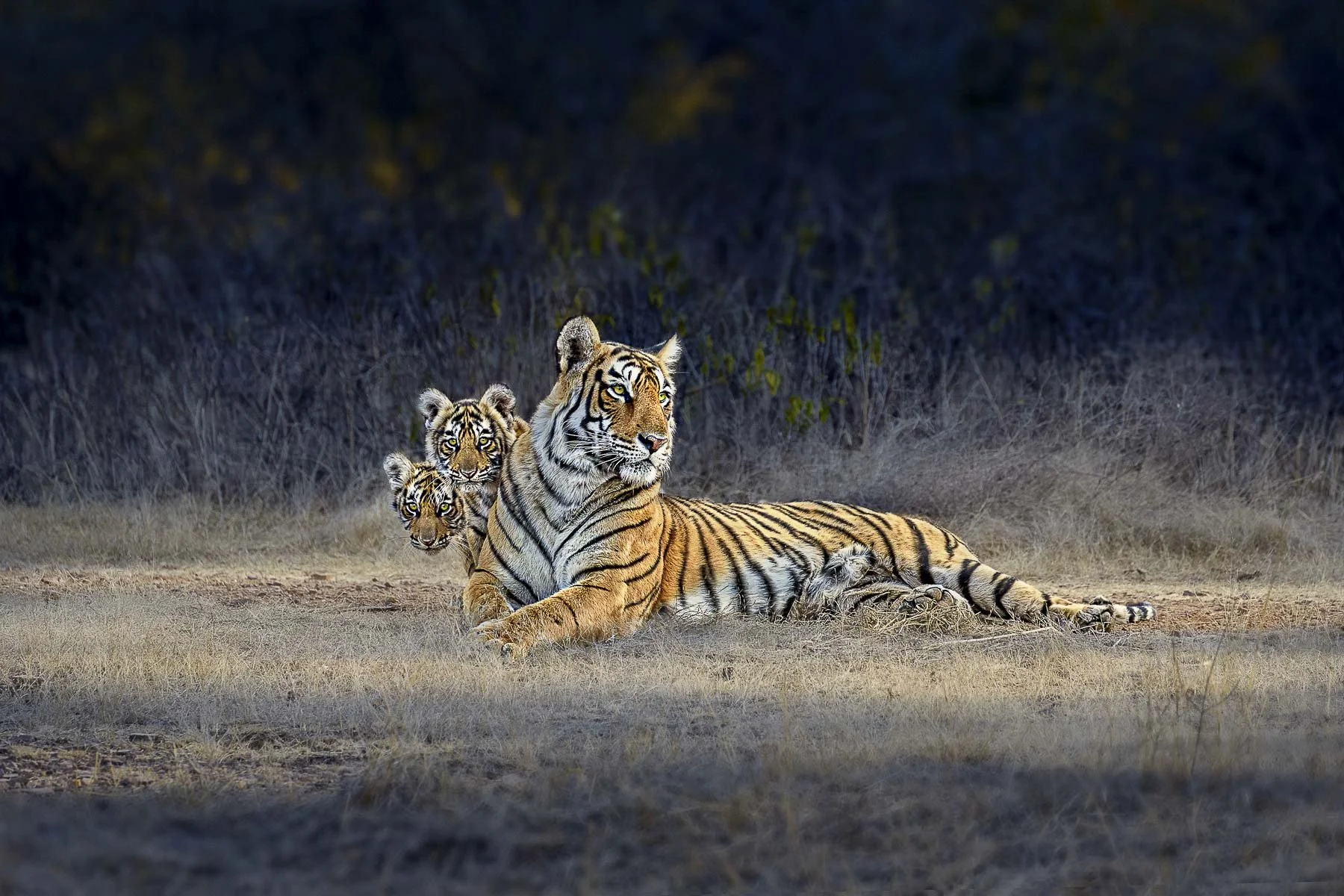

Arrowhead came out of the trees alone. That was the first thing I noticed. The second was that she kept looking back.
It was a morning in March 2019 in Ranthambore, Rajasthan. The grass in the clearing had gone pale, and beyond it the forest was dense enough to swallow the shape of a tiger. When she stepped into the open, there was no mistaking her. Her stripes came into focus against the scrub; then she turned towards the vehicles and walked directly across our field of view.
For a wildlife photographer, there is a reflex in that moment: find the light, lift the camera, stay ready. But I had spent enough time in the field to know that a tiger’s route is not a composition I can arrange. Arrowhead was choosing where to go. I could only try to keep up.

By then she was among Ranthambore’s most recognisable animals. Identified as T-84, Arrowhead was a granddaughter of Machli, the tigress whose long life made the park’s lake country famous. Her mother, Krishna, had held that territory before her. Local observers recorded Arrowhead taking over the lakes in 2017, after years in which the young tigress had challenged the older one.1
The succession sounds almost ceremonial when told later. In the wild, it is a contest for space, prey and the chance to raise young. Arrowhead’s first litter in 2018 did not survive. When two new cubs were first seen with her on 2 January 2019, the news mattered far beyond the safari vehicles that happened to be there.2 I did not know all of that as I framed her approach. I knew only that she had emerged alone, and that she was attentive to something behind her.
What the grass concealed
She stopped, glanced back along the tree line and looked across the clearing. Then she lay down. The urgency that had carried me through the first frames gave way to a different kind of attention. There was still a tiger in front of us, but almost nothing was happening. I kept watching.

That is one of the misleading things about a quiet wildlife scene. The frame feels settled, yet the animal is registering sounds and movement we cannot read. I cannot say what Arrowhead was checking, or whether she had considered us at all. I can say that she looked back towards the cover before she rested. A little later, the grass behind her began to move.
Two young faces appeared beside her body.
At first the cubs were hesitant. They stayed close to Arrowhead, peering past her shoulder and retreating into the striped shelter of her flank. A park sighting log had recorded her new cubs only weeks earlier.2 From our side of the clearing, they seemed impossibly small against the animal whose reputation filled so much of Ranthambore.

We often speak about a mother showing her young to people, as though the sighting has been staged for us. That was the feeling in the vehicle: Arrowhead had come out first, settled, and then the cubs had appeared. But a photograph cannot establish intention. It records something more valuable than a neat explanation: the particular distance they kept from her, the way they looked out, and the fact that she remained there while they did.
The cubs would later be known as Riddhi and Siddhi, according to Ranthambore observers, though I cannot identify which sister is which in these frames.1 At the time, they were simply two young tigers testing the space around their mother.

What it takes to grow up here
There is a reason I remember their size. In an adult tiger, we tend to see power. In a cub, the dependence is impossible to overlook. The playful movement that followed looked carefree from a vehicle, but a young tiger’s survival depends on its mother, the territory she can hold and the hazards neither can control.
A study of Ranthambore’s tiger population between 2006 and 2014 followed 97 known animals. It recorded 17 deaths among cubs and juveniles; among those deaths, researchers attributed 41 per cent to natural causes, including infanticide and the loss of the mother, and 47 per cent to human causes, including poaching and accidents.3 These figures do not describe the fate of Arrowhead’s cubs. They make clear what is at stake whenever a litter appears in the park.
The two in front of us grew more confident. One climbed against Arrowhead while the other moved through the grass beside her. Their small bodies briefly turned her into a climbing frame. She stayed down as they shifted around her, and I photographed the movement without trying to reduce it to a single perfect pose.

People imagine wildlife photography as the instant a shutter closes. Much of its meaning is in the minutes on either side: the long uncertainty before an animal appears, the decision to keep watching after the obvious portrait has been made, the knowledge that nothing you do can ask a wild subject to repeat itself. On this occasion the strongest pictures were made possible by not deciding too soon that the sighting was over.
Ranthambore had already shown how precarious a tiger’s future could be beyond any one clearing. After tigers disappeared from nearby Sariska, India’s National Tiger Conservation Authority began reintroducing animals from Ranthambore in 2008.4 The programme is a reminder that a celebrated tiger is also part of a vulnerable population and a larger landscape. Photographs can make an individual familiar. They cannot, by themselves, protect the habitat and prey on which her descendants depend.
Beyond Arrowhead’s legend
Arrowhead died on 19 June 2025, aged about 11.5 Obituaries reached for the familiar language of queens and dynasties. She had inherited the lakes from Krishna, hunted crocodiles like Machli, and raised daughters who would later contend for space of their own. Those events are part of her history. They are also the story of an animal whose life continued when the vehicles went home and the cameras were put away.
When I return to these photographs, I do not begin with the legend. I begin with a small hesitation at the edge of the forest. Arrowhead walking into the open. Her glance back. The moment I realised there was more than one tiger in the clearing.

The last frame in this selection holds the three of them together. I have no photograph of their departure, and I do not need to invent one. What I was given was a brief view into a life that did not belong to us: a mother at rest, two cubs growing bolder, and the pale grass around them.
That is what remains after the names, the territories and the headlines. Arrowhead came out alone. For a little while, she was not.
John Wiseman photographed Arrowhead in Ranthambore in March 2019. This first-person feature was developed from his supplied account and photographs; John should review the recollected details before publication.